
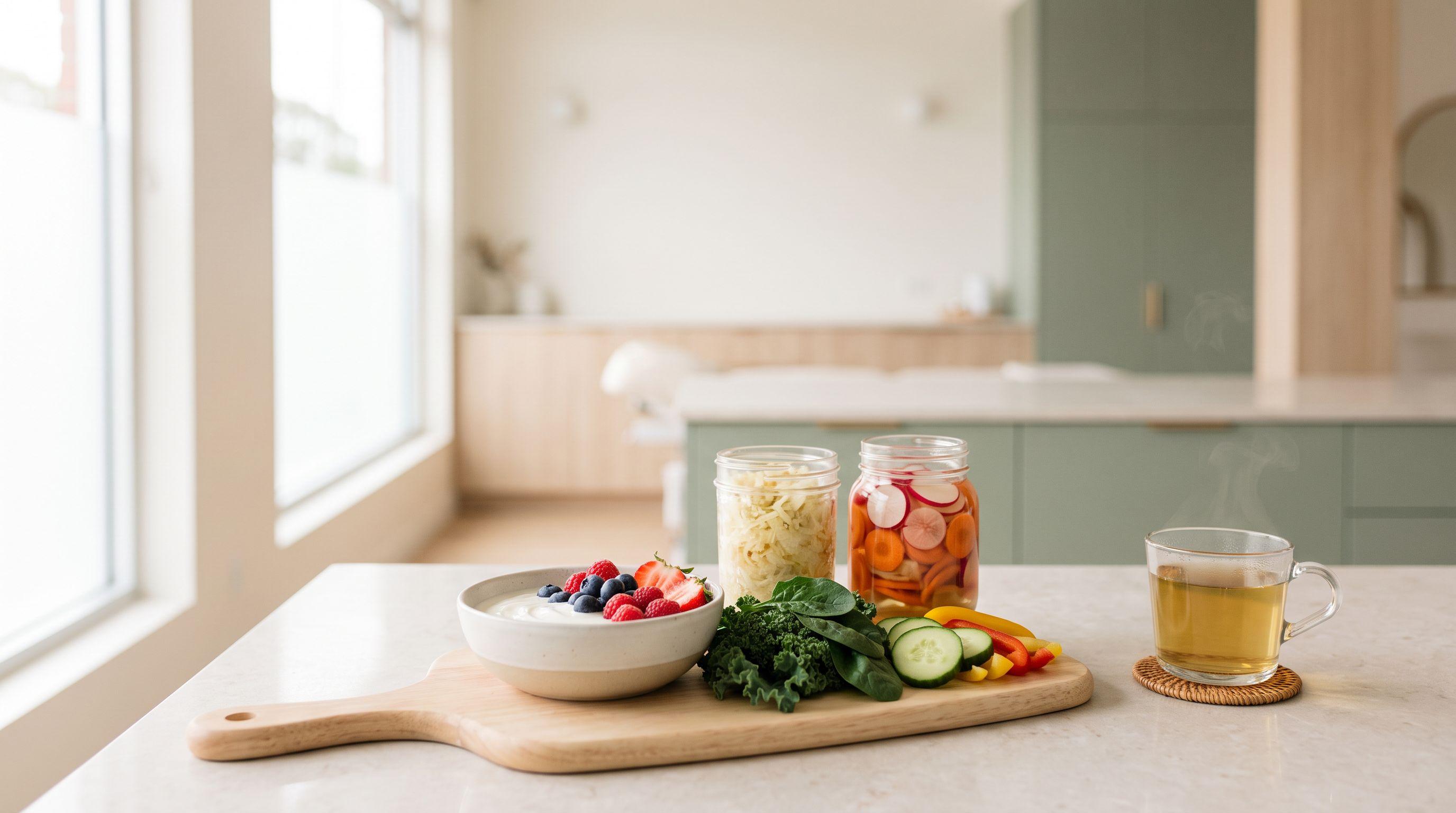
Yes, your gut and your skin talk to each other. The honest version of that story is narrower than the version you will find on social media. The strongest evidence sits with rosacea, where several digestive conditions turn up more often than chance would predict. For acne, the clearer link is what you eat and how it moves your insulin, not the bacteria themselves. And no stool or blood test sold today can diagnose a leaky gut. Working on your gut can genuinely help your skin. It is rarely a substitute for treating the skin itself.
What the gut-skin axis actually means
The gut-skin axis describes two-way traffic between the digestive tract and the skin, carried by immune signalling, whole-body inflammation and the compounds gut bacteria produce. It is a legitimate research field, not a marketing invention. It is also young. A 2025 narrative review in the World Journal of Gastrointestinal Pathophysiology surveyed the evidence and concluded that it remains unclear whether microbiome imbalances directly drive skin inflammation or simply reflect a body already primed for it, and that some findings may be confounded by environmental exposures (narrative review).
Hold on to that distinction. Association means two things show up together. Causation means fixing one fixes the other. Most gut-skin content online quietly converts the first into the second.
Rosacea has the strongest gut connection
If you have rosacea, the gut is worth a real look. A 2021 review in Advances in Therapy catalogued the digestive conditions that occur more often in people with rosacea: inflammatory bowel disease, celiac disease, irritable bowel syndrome, reflux, Helicobacter pylori infection and small intestinal bacterial overgrowth (review). That same review describes patients whose rosacea resolved or greatly improved after SIBO was eradicated, with skin staying in remission for months without other treatment.
That is genuinely interesting. It is also a small body of work. A 2024 cross-sectional study in Cureus tested 27 people with rosacea and found about a third positive for SIBO and roughly one in seven positive for H. pylori. The authors were careful to say it remains incompletely understood whether SIBO contributes to rosacea or whether both are downstream effects of the same underlying immune abnormality (study). Twenty-seven patients is a signal, not a verdict.
The practical read: rosacea plus ongoing digestive symptoms makes testing for SIBO or H. pylori reasonable. If your digestion is genuinely fine, a gut workup is unlikely to unlock your skin. Sun, heat, alcohol and stress remain the triggers you can act on, and daily broad-spectrum sunscreen is still the highest-yield habit there is (AAD).
Acne: the food link is stronger than the bacteria link
For acne the evidence points somewhere slightly different. The American Academy of Dermatology’s position is that following a low-glycemic diet may reduce the amount of acne you have, and that cow’s milk shows a signal where other dairy does not. Women drinking two or more glasses of skim milk a day were more likely to have acne, while no studies have found that yogurt or cheese lead to more breakouts (AAD).
Notice what that is describing. It is a blood sugar and insulin story more than a microbiome story. It also comes with the AAD’s own caveat, which is worth repeating rather than burying: keeping your skin clear requires more than a diet change. Diet is an adjunct. It is not a treatment plan.
The part most gut-skin articles leave out
Three limitations, stated plainly.
Leaky gut is not something you can test for. A 2024 paper in Gastroenterology and Hepatology puts it directly: leaky gut syndrome is not currently accepted as a formal medical diagnosis, no blood test to diagnose it exists, commercial zonulin assays are methodologically flawed, and the stool tests marketed for it are unregulated with minimal evidence supporting their use (paper). Intestinal permeability is a real phenomenon under active study. The consumer test claiming to measure yours is not the same thing.
Probiotics for acne are promising, not proven. A 2025 systematic review and meta-analysis in Medicina pooled three double-blind randomised trials covering 231 people and found a modest reduction in inflammatory lesions. Its own prediction interval, however, left room for no meaningful effect at all, certainty of evidence was rated low to moderate, and the authors described their findings as preliminary and hypothesis-generating rather than definitive (meta-analysis). Three small trials is not a reason to build your skincare around a supplement. We have written separately on what probiotics actually do.
Food sensitivity panels will not find your acne trigger. IgG food panels are not validated for this purpose, and in practice they send people into long restriction lists that cost them nutrition and social life without clearing their skin.
What a sensible workup looks like
In our gut health and functional medicine visits, this question gets handled in roughly the following order.
- A real digestive history first, because gut testing earns its place when there are gut symptoms
- The ordinary medical causes ruled in or out early: hormonal drivers in adult female acne, thyroid disease, and medications that are known to cause breakouts
- Testing for SIBO or H. pylori when the history supports it, not reflexively
- Dietary change you can actually keep, usually glycemic load and a trial off cow’s milk, rather than a long elimination list
- Skin-directed treatment continuing in parallel, because that is what does the heavy lifting for visible results, whether prescription therapy or a procedural option like PRP or exosomes
A fair trial of dietary change takes weeks, not days. If nothing has shifted after two months of consistent effort, that is a reason to change the plan rather than add another supplement.
Red flags that mean see a clinician, not a supplement
- Blood in your stool, black stools, unintended weight loss or persistent vomiting
- New flushing that comes with diarrhoea, wheezing or palpitations, which can point to something other than rosacea
- Grittiness, burning or blurred vision alongside rosacea, which suggests eye involvement and needs assessment
- Sudden severe acne in an adult woman with irregular periods, hair thinning or new facial hair
- Acne that is leaving scars, or any lesion that bleeds, hardens or will not heal
- Deep painful lumps in the armpits or groin, which is not ordinary acne
Skin that changes suddenly is information. It deserves a diagnosis before it gets a protocol.
Medically reviewed by Krishna Borges, MSN, APRN, FNP-C. This article is for general education and is not a substitute for individual medical advice.